

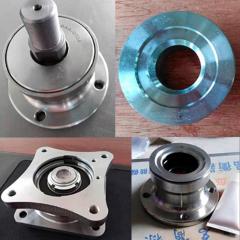
Truck wheel bearings operate under demanding conditions. In addition to supporting vehicle and axle loads, they are exposed to braking forces, cornering loads, road impacts, vibration, temperature changes, and long operating hours.
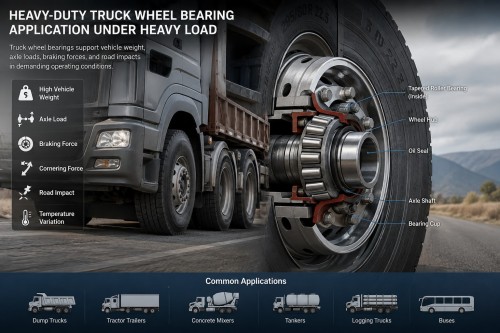
So why do truck wheel bearings fail prematurely?
Heavy load and poor lubrication are the primary failure mechanisms examined in this article. Other factors, including preload, endplay, contamination, misalignment, installation, and temperature, can amplify their effects and accelerate bearing damage.
The critical issue is often the interaction between load and lubrication:
Heavy Load
→ Higher Contact Stress
Poor Lubrication
→ Reduced Surface Protection
Higher Stress + Reduced Surface Protection
→ Friction and Surface Interaction
→ Heat and Lubricant Degradation
→ Raceway and Roller Damage
→ Uneven Load Distribution
→ Accelerated Fatigue
Understanding this failure mechanism can help fleet maintenance teams, OEM engineers, bearing distributors, and purchasing professionals identify root causes instead of simply replacing failed bearings.
How Heavy Loads Affect Truck Wheel Bearings
A truck wheel bearing does not experience only the static weight of the vehicle. Actual wheel-end loading changes continuously as the vehicle accelerates, brakes, turns, carries different payloads, and travels over uneven roads.
Radial and Axial Loads
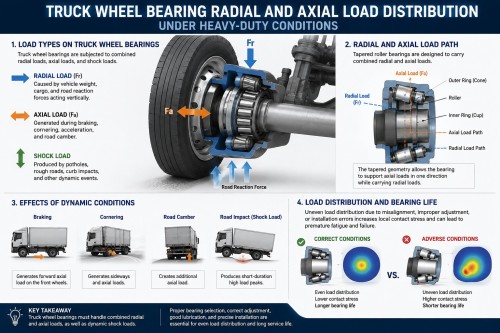
Radial loads are primarily associated with vehicle and axle loads acting through the wheel. Axial or thrust loads can develop during cornering, braking, and other dynamic operating conditions.
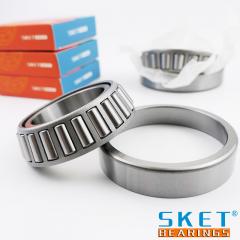
Tapered roller bearings are widely used in heavy-duty wheel-end applications because their geometry allows them to accommodate combined radial and axial loads. Their tapered rollers and raceways distribute these forces through controlled rolling contact.
For more information about tapered roller bearing geometry and combined loading, see How Does a Tapered Roller Bearing Work?
Shock Loads and Dynamic Wheel-End Forces
Normal vehicle loading can be relatively predictable, but potholes, rough roads, curb impacts, and other road conditions can create short-duration shock loads.
Braking and cornering can also change the load distribution across the wheel-end bearing arrangement.
These dynamic forces become more critical when the bearing has:
-
Incorrect preload or endplay
-
Poor seating
-
Misalignment
-
Damaged mating components
-
Unfavorable load distribution
A bearing may operate within its nominal load rating under steady conditions while still experiencing significantly higher localized contact stress during short-duration shock events.
Bearing life therefore depends not only on the total load carried by the bearing, but also on how that load is distributed across the rolling elements and raceways.
How Poor Lubrication Causes Truck Wheel Bearing Damage
Lubrication is not simply about preventing metal-to-metal contact. The lubricant also helps control friction and temperature, protect rolling surfaces, and maintain an appropriate operating environment inside the bearing.
The Role of the Lubricating Film
Under suitable operating conditions, a lubricant film separates contacting surfaces and reduces direct surface interaction.
The effectiveness of this film depends on several factors, including:
-
Lubricant viscosity
-
Operating temperature
-
Bearing speed
-
Applied load
-
Surface roughness
-
Bearing geometry
-
Lubricant condition
Under otherwise comparable conditions, higher load can reduce the effective lubrication film between contacting surfaces and increase the risk of mixed or boundary lubrication.
This is why lubrication should always be evaluated together with the actual operating conditions rather than treated as an independent maintenance item.
Friction, Heat and Surface Interaction
When lubrication becomes inadequate, surface interaction can increase.
The resulting process can develop into a self-reinforcing cycle:
Reduced Lubrication Protection
→ Increased Friction and Surface Interaction
→ Higher Operating Temperature
→ Lubricant Degradation
→ Further Reduction in Lubrication Performance
As this cycle progresses, the rolling surfaces may become more susceptible to wear, scoring, smearing, surface distress, and rolling contact fatigue.
Poor lubrication does not necessarily mean insufficient grease. Lubrication performance can also deteriorate because of:
-
Incorrect grease selection
-
Lubricant aging
-
Water contamination
-
Dirt or abrasive particles
-
Excessive operating temperature
-
Inappropriate relubrication practices
Why More Grease Is Not Always Better
Adding more grease is not automatically a solution to lubrication problems.
In some bearing arrangements, excessive grease can increase churning and friction, resulting in additional heat generation.
The objective should therefore be the correct lubricant, quantity, and maintenance practice for the specific wheel-end design, rather than simply maximizing the amount of grease.
How Heavy Load and Poor Lubrication Work Together
This is the central failure mechanism behind many premature truck wheel bearing problems.
Heavy loading increases the stress at the roller-to-raceway contact. At the same time, poor lubrication reduces the surface protection available at that contact.
The two conditions can therefore reinforce each other.
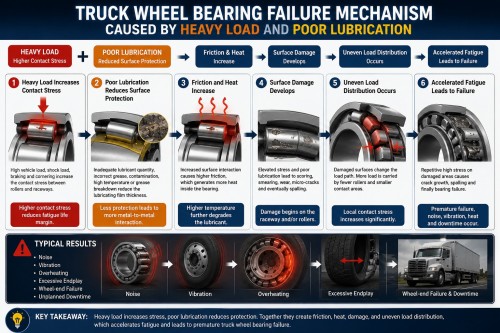
The Failure Mechanism
Stage 1 — Heavy Load Increases Contact Stress
As the applied load increases, rolling elements and raceways experience higher contact stress.
This does not mean that every load increase immediately causes failure. Bearing life depends on the complete operating condition, including load distribution, lubrication, speed, temperature, contamination, and adjustment.
Stage 2 — Poor Lubrication Reduces Surface Protection
If the lubricant film becomes inadequate, the rolling surfaces have less protection against direct surface interaction.
This may occur because of insufficient lubricant, unsuitable viscosity, contamination, lubricant degradation, or excessive temperature.
Stage 3 — Friction and Heat Increase
Greater surface interaction can increase friction and heat generation.
Elevated temperature can then accelerate lubricant degradation, making the lubrication condition even less favorable.
Stage 4 — Surface Damage Develops
Depending on the operating conditions, damage may appear as:
-
Raceway wear
-
Roller scoring
-
Smearing
-
Surface distress
-
Fatigue cracking
-
Spalling
Stage 5 — Load Distribution Becomes Less Uniform
Once rolling surfaces become damaged, the intended contact geometry can change.
The damaged area may no longer distribute load normally, creating additional localized stress concentration. This can further accelerate surface damage and rolling contact fatigue.
The overall mechanism can be summarized as:
Heavy Load
→ Higher Contact Stress
Poor Lubrication
→ Reduced Surface Protection
Higher Stress + Reduced Surface Protection
→ Friction and Surface Interaction
→ Heat and Lubricant Degradation
→ Surface Damage
→ Uneven Load Distribution
→ Further Stress Concentration
→ Accelerated Fatigue
This explains why heavy loading and poor lubrication can be significantly more damaging when they occur together than when either condition is considered in isolation.
Common Internal Damage in Failed Truck Wheel Bearings
External symptoms can indicate that a truck wheel bearing has a problem, but the internal damage pattern is often more useful when determining the probable failure mechanism.
A separate guide, Truck Wheel Bearing Failure Symptoms and Warning Signs, focuses on identifying external warning signs. This article focuses on internal damage and contributing mechanisms.
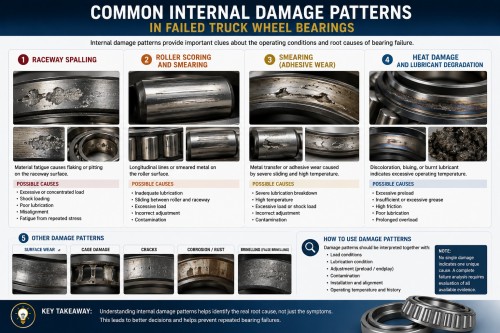
Raceway Fatigue and Spalling
Rolling contact fatigue develops when repeated contact stresses eventually initiate surface or subsurface damage.
As fatigue progresses, cracks can lead to material separation and spalling on raceway or roller surfaces.
High or concentrated loading can accelerate this process, particularly when lubrication is inadequate.
When spalling is identified, the investigation should consider:
-
Actual operating load
-
Load distribution
-
Lubrication condition
-
Bearing adjustment
-
Contamination
-
Operating temperature
-
Installation condition
Roller Scoring and Smearing
Scoring and smearing indicate abnormal surface interaction and sliding rather than normal rolling contact alone.
Possible contributing conditions include inadequate lubrication, excessive sliding, unfavorable load distribution, and abnormal operating conditions.
The exact damage pattern should always be interpreted together with the bearing's operating history.
Overheating and Lubricant Degradation
Heat-related discoloration or degraded lubricant can provide evidence of excessive operating temperature.
Potential contributors include:
-
Excessive preload
-
Insufficient lubrication
-
Excessive grease
-
High friction
-
Incorrect adjustment
-
Abnormal operating conditions
However, discoloration alone should not be treated as proof of a single failure mechanism. The bearing damage pattern and operating history should be evaluated together.
What Damage Patterns Can Tell You
Bearing damage should not be interpreted as a simple one-to-one relationship between one visible defect and one cause.
A more reliable approach is:
Damage Pattern + Operating Conditions + Maintenance History = Probable Root Cause
| Internal Damage | Possible Contributing Mechanisms |
|---|---|
| Raceway spalling | Rolling contact fatigue, excessive or concentrated loading |
| Roller scoring | Inadequate lubrication, sliding, abnormal surface interaction |
| Smearing | Sliding, insufficient lubrication, unfavorable operating conditions |
| Heavy discoloration | Excessive temperature or friction |
| Surface wear | Contamination, poor lubrication, abnormal contact |
| Cage damage | Misalignment, vibration, lubrication, or installation issues |
These relationships are diagnostic guidelines rather than automatic conclusions. A complete failure analysis should evaluate the entire damage pattern and application history.
For systematic rolling bearing damage classification, ISO 15243 provides an established framework for describing and classifying bearing damage and failure modes.
Other Factors That Accelerate Truck Wheel Bearing Failure
Heavy load and poor lubrication are the primary focus of this article, but several application factors can amplify their effects.
These factors can increase contact stress, disturb load distribution, accelerate lubricant degradation, or create abnormal surface interaction inside the bearing.
Premature truck wheel bearing failure is often the result of multiple conditions acting together, rather than a single isolated problem.
Actual Operating Conditions and Dynamic Loads
A bearing's rated load provides an important basis for selection, but it does not fully represent the forces experienced by a truck wheel-end during real-world operation.
Actual loading can vary with:
-
Vehicle and axle load
-
Payload variation
-
Braking and cornering
-
Road surface conditions
-
Shock loading
-
Duty cycle
-
Operating speed
A wheel bearing may operate within its nominal load rating under steady conditions but experience significantly higher short-duration forces when the vehicle encounters a pothole or other severe road impact.
These dynamic load peaks can become more damaging when bearing adjustment, alignment, or seating conditions are already unfavorable.
Therefore, bearing selection should consider the actual operating load profile, rather than relying only on nominal vehicle weight or catalog load ratings.
Preload and Endplay: Controlling Load Distribution
Bearing adjustment is particularly important in truck wheel-end applications using tapered roller bearings.
Excessive preload can increase friction and heat generation:
Excessive Preload → Higher Friction → Higher Temperature → Lubricant Degradation
If the operating temperature continues to rise, lubricant performance may deteriorate further, reducing the protection available at the roller-to-raceway contacts.
By contrast, excessive endplay can allow unwanted internal movement and alter the intended distribution of load among the rollers.
The objective is therefore not simply to minimize preload or endplay. The bearing should be adjusted according to the requirements of the specific wheel-end system and bearing arrangement.
Correct adjustment helps maintain the intended internal geometry and load distribution during operation.
Contamination and Misalignment
Contamination can further increase the effects of heavy loading and poor lubrication.
Water, dirt, road debris, and abrasive particles can enter the wheel-end environment and affect both the lubricant and rolling surfaces.
Contamination may contribute to:
-
Abrasive wear
-
Raceway surface damage
-
Roller surface damage
-
Lubricant degradation
-
Increased friction
-
Premature fatigue
The risk becomes greater when the bearing operates under high load because contaminated or damaged surfaces are subjected to repeated rolling contact stress.
Misalignment can create another form of localized loading.
When the shaft, hub, housing, or bearing arrangement is not properly aligned, the rollers may not contact the raceways as intended. This can result in uneven load distribution and higher local contact stress.
The resulting mechanism can be represented as:
Misalignment → Uneven Load Distribution → Localized Contact Stress → Accelerated Surface Damage
When heavy loading is already present, even relatively small alignment problems can become more significant.
Installation and Temperature
Correct installation is another important part of maintaining the intended bearing operating condition.
Even a correctly selected bearing can experience premature damage if it is improperly seated, adjusted, or mounted.
Important installation conditions include:
-
Proper bearing seating
-
Correct mounting force
-
Correct adjustment procedure
-
Shaft and housing condition
-
Alignment
-
Seal condition
-
Preload or endplay
-
Clean installation environment
Improper installation can introduce damage before the bearing reaches normal service conditions or create an unfavorable internal load distribution during operation.
Temperature should also be considered together with load and lubrication.
High operating temperatures can reduce lubricant viscosity, accelerate lubricant degradation, and increase the risk of surface distress. At the same time, excessive friction caused by preload, inadequate lubrication, or other abnormal conditions can further increase temperature.
This creates another potential feedback loop:
Abnormal Operating Condition → Higher Friction → Higher Temperature → Lubricant Degradation → Reduced Surface Protection
For this reason, temperature should not be treated as an independent variable. It is often both a result of abnormal bearing operation and a factor that accelerates further damage.
How to Prevent Premature Truck Wheel Bearing Failure
Once the main failure mechanisms are understood, prevention should focus on controlling the operating conditions that can accelerate bearing damage.
Rather than treating load, lubrication, adjustment, contamination, and installation as separate problems, fleet maintenance teams and OEM engineers should evaluate them as part of the same wheel-end system.
A practical prevention process can be simplified into four steps.
1. Confirm the Real Wheel-End Operating Conditions
Start with the actual application rather than the bearing catalog alone.
Review:
-
Axle and wheel-end loads
-
Payload variation
-
Braking and cornering conditions
-
Road surface and shock loading
-
Operating speed
-
Temperature
-
Duty cycle
The objective is to determine whether the bearing is operating under the conditions assumed during selection.
Particular attention should be given to applications with highly variable payloads, severe road conditions, or frequent shock loading.
2. Verify Bearing, Lubrication, and Adjustment Compatibility
Once the operating conditions are understood, verify that the complete bearing arrangement is suitable for them.
The review should include:
-
Bearing type and load capacity
-
Bearing arrangement
-
Lubricant specification
-
Lubricant quantity
-
Operating temperature
-
Preload or endplay requirements
-
Sealing and contamination protection
These parameters should be considered together because changing one operating condition can affect the others.
For example, excessive preload can increase friction and temperature, while an unsuitable lubricant can reduce surface protection under high load.
The goal is not simply to select a bearing with a higher load rating, but to establish a compatible combination of bearing, lubrication, adjustment, and wheel-end components.
3. Control Installation and In-Service Conditions
Correct installation is essential for maintaining the intended bearing geometry and load distribution.
Before the vehicle returns to service, verify:
-
Bearing seating
-
Shaft, hub, and housing condition
-
Mounting procedure
-
Adjustment condition
-
Alignment
-
Seal condition
-
Lubricant condition
During service, maintenance teams should also monitor changes that may indicate developing problems, such as abnormal temperature, noise, vibration, lubricant deterioration, or repeated damage at the same wheel position.
This allows abnormal operating conditions to be identified before they develop into severe internal bearing damage.
4. Inspect Failed Bearings Before Replacement
When a bearing fails prematurely, replacement should not automatically be the final action.
Inspect the failed bearing and record:
-
Raceway damage
-
Roller damage
-
Cage condition
-
Wear pattern
-
Spalling
-
Scoring or smearing
-
Discoloration
-
Lubricant condition
-
Contamination
-
Installation condition
The purpose is to determine whether the failure is primarily associated with loading, lubrication, adjustment, contamination, alignment, installation, or a combination of factors.
If the same wheel position repeatedly experiences premature failure, the application should be investigated before installing another replacement bearing.
From Replacement to Root-Cause Prevention
The most effective maintenance strategy is not simply to replace failed bearings faster. It is to identify the operating condition that caused the failure and remove or control that condition.
A useful diagnostic sequence is:
Operating Conditions
↓
Bearing and Wheel-End Configuration
↓
Lubrication and Adjustment
↓
Installation and In-Service Condition
↓
Failure Evidence
↓
Root-Cause Analysis
This approach helps fleet operators and OEM engineers move from reactive replacement toward more predictable wheel-end reliability and maintenance planning.
Tapered Roller Bearings for Heavy-Duty Truck Wheel Ends
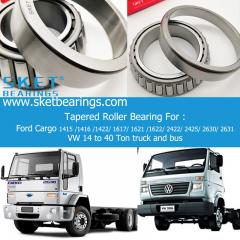
Tapered roller bearings are widely used in heavy-duty truck wheel-end applications because their geometry allows them to support combined radial and axial loads.
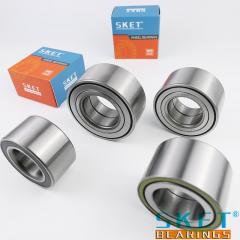
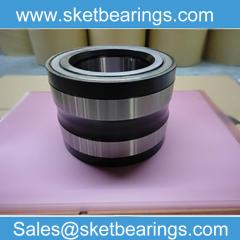
Depending on the wheel-end design, engineers may encounter single-row tapered roller bearings, paired bearing arrangements, double-row designs, or integrated hub units.
However, selection should not be based solely on dimensional interchangeability.
Engineers and purchasing teams should also consider:
-
Load conditions
-
Bearing arrangement
-
Adjustment requirements
-
Lubrication
-
Sealing
-
Installation
-
Serviceability
-
Expected operating life
For a broader comparison of traditional tapered roller bearing arrangements and integrated hub units, see Tapered Roller Bearings vs Hub Units for Trucks.
When Should a Truck Wheel Bearing Be Replaced?
Truck wheel bearings should not be replaced based on mileage alone.
Inspection should focus on actual bearing condition and whether the bearing can continue to meet the requirements of the wheel-end system.
Replacement should be considered when inspection identifies:
-
Raceway spalling
-
Significant roller damage
-
Severe scoring or smearing
-
Advanced surface fatigue
-
Abnormal wear
-
Heat-related damage
-
Severe lubricant degradation
-
Dimensional or geometry changes
-
Damage that prevents correct adjustment
If the same wheel position experiences repeated premature failures, replacing the bearing without investigating the underlying cause may simply repeat the failure cycle.
For fleet operators and purchasing teams evaluating replacement decisions from a lifecycle-cost perspective, see Truck Wheel Hub Bearing Replacement Cost & Lifecycle Decision Model.
Truck Wheel Bearing Failure Prevention Checklist
| Inspection Area | Key Question |
|---|---|
| Operating Conditions | Is the actual wheel-end load and duty cycle understood? |
| Bearing & Adjustment | Is the bearing arrangement correctly selected and adjusted? |
| Lubrication | Is the lubricant suitable in type, quantity, and temperature range? |
| Contamination & Sealing | Are water, dirt, and abrasive particles adequately controlled? |
| Installation & Alignment | Are seating, mounting, alignment, and mating components acceptable? |
| Failure Analysis | Was the failed bearing inspected before replacement? |
Using this checklist can help maintenance teams move from reactive bearing replacement toward systematic failure prevention.
FAQ
Why do truck wheel bearings fail under heavy load?
Heavy loading increases the contact stress between rolling elements and raceways. If the load is concentrated because of unfavorable adjustment, alignment, seating, or shock loading, localized contact stress can become even higher. When lubrication is also inadequate, the rolling surfaces have less protection, increasing the risk of surface damage and fatigue.
How does poor lubrication cause truck wheel bearing failure?
Poor lubrication can reduce the protection between contacting surfaces, increasing friction, heat, wear, and surface distress. If elevated temperature further degrades the lubricant, the resulting feedback loop can accelerate bearing damage.
Can a truck wheel bearing fail even if it is within its rated load?
Yes. Rated load is an important selection parameter, but it does not guarantee a specific service life under every operating condition. Lubrication, contamination, adjustment, alignment, installation, temperature, and shock loading can all affect actual bearing life.
How do preload and endplay affect truck wheel bearing life?
Excessive preload can increase friction and temperature, while excessive endplay can alter internal load distribution and increase unwanted movement. Both conditions can contribute to premature damage when they fall outside the specified adjustment range.
Conclusion: Treat Truck Wheel Bearing Failure as a System Problem
Truck wheel bearing failure is rarely caused by a single variable.
Heavy load increases contact stress. Poor lubrication reduces surface protection. Incorrect adjustment changes load distribution. Contamination accelerates wear. Installation and alignment determine whether the bearing operates as intended.
The critical mechanism is often the interaction between these factors:
Heavy Load
→ Higher Contact Stress
Poor Lubrication
→ Reduced Surface Protection
Higher Stress + Reduced Surface Protection
→ Friction and Surface Interaction
→ Heat and Lubricant Degradation
→ Surface Damage
→ Uneven Load Distribution
→ Accelerated Fatigue
For fleet operators, OEM engineers, distributors, and bearing purchasing teams, the solution is therefore not simply to choose a bearing with a higher load rating.
A more reliable approach is to evaluate the complete wheel-end system:
Bearing Selection + Lubrication + Adjustment + Installation + Contamination Control + Failure Analysis
For purchasing teams, a higher load rating alone should not be treated as a complete solution to repeated wheel bearing failures. The bearing, lubrication, adjustment, installation, and service conditions should be evaluated as one system.
This system-level approach can help identify the real causes of premature truck wheel bearing failure, reduce unnecessary replacement, and support more predictable wheel-end maintenance and operating costs.