

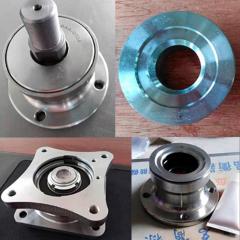
Introduction – Why Torque and Fit Matter More Than Bearing Quality
In agricultural applications, bearing failures are often attributed to product quality. However, field experience shows that many failures originate from improper installation rather than manufacturing defects.
For square bore disc harrow bearings, incorrect torque application and poor shaft fit are among the most common causes of premature failure.
- Unexpected downtime during peak farming seasons
- Increased warranty and replacement costs
- Reduced reliability for end users
In practice, torque and fit are not minor details—they directly determine bearing performance.
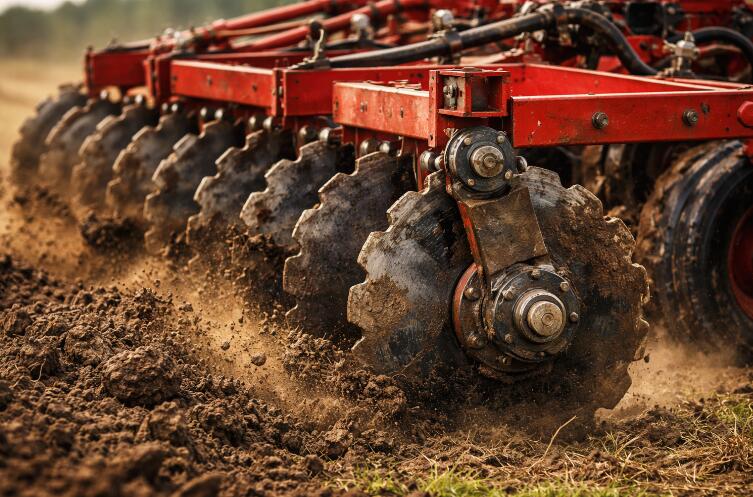
Understanding Square Bore Load Transfer in Real Working Conditions
Square bore bearings transmit torque through direct surface contact rather than friction. This makes them ideal for high-load agricultural applications, but also more sensitive to installation accuracy.
Stress concentration typically occurs at:
- Shaft corners
- Uneven contact surfaces
- Dimensional mismatches
In abrasive soil environments, these issues can accelerate wear. For more on bearing selection under different soil conditions, refer to: Disc Harrow Bearings for Different Soil Conditions: How to Choose the Right Bearing.
Torque Application – A Hidden but Critical Variable
In the field, mechanics rarely have the luxury of lab analysis. Knowing the observable symptoms of torque issues is critical for quick diagnosis.
What Happens When Torque Is Too Low
- Field Signal: Bolt loosening or backing off within the first 10–20 operating hours.
- Mechanical Consequence: Micro-fretting between shaft and bearing, unstable load transfer, and premature seal failure due to movement.
What Happens When Torque Is Too High
- Field Signal: Abnormal temperature rise at the bearing housing during initial run-in (often felt before it is measured).
- Mechanical Consequence: Housing deformation, increased friction, internal overloading, and significantly reduced bearing fatigue life.
Best Practices
- Use a calibrated torque wrench (calibration recommended every quarter)
- Follow supplier-recommended torque ranges (e.g., M16 bolt, Grade 8.8: 120–150 N·m)
- Consider lubrication conditions and bolt status (dry vs. oiled – torque coefficient can vary by up to 30%)
Note :Actual values depend on thread lubrication and friction coefficient; always verify with supplier.
Fit Tolerance – Controlling the Interface Between Shaft and Bearing
Why Interference Fits Are Risky for Square Bores
Unlike round bore bearings, square bore structures are highly sensitive to interference. Excessive interference can distort the geometry of the bore’s flat planes, leading to uneven corner loading and accelerated localized wear. A proper clearance fit is essential to preserve the square geometry under load.
Loose Fit Issues
- Vibration and fretting corrosion
- Uneven load distribution across the four driving faces
- Accelerated wear on the shaft and bearing corners
Over-Tight Fit Risks
- Excessive preload and housing stress
- Higher starting resistance
- Deformation of internal raceway or cage
Recommended Tolerance Control
- Fit Recommendation: ISO H7/f7 or similar clearance fit (ensures minimal clearance to avoid square bore deformation while preventing excessive play).
- Pre-Batch Inspection: Perform cross-section consistency checks before batch production using a micrometer or caliper gauge.
Critical Control Point – Square Bore Geometry
This is where the majority of field misdiagnoses occur. Dimensional issues are often blamed on bearing quality when the root cause is shaft or bore geometry.The Risk of Diagonal Deviation
Square bore bearings transfer load through their four corners. Even small diagonal deviations can shift load from a balanced four-corner distribution to single-corner contact.Threshold: Diagonal deviation >0.1 mm for typical 40–60 mm square bores (or >0.15% of diagonal length).
Result: This creates a dangerous stress concentration point, drastically reducing bearing life and leading to catastrophic corner fracture under heavy draft loads.
Note: Diagonal dimension control is significantly more critical than individual side dimension control for square bores.
How Torque and Fit Influence Sealing Performance
Incorrect installation affects sealing performance directly:
- Improper torque → Altered seal compression
- Poor fit → Uneven seal contact pressure
Consequences:
- Contamination ingress in abrasive soil conditions
- Lubrication starvation
- Significantly shortened bearing life
For high-contamination environments, relubricatable designs are worth considering. See:When Should You Choose Relubricable Disc Harrow Bearings?
Common Field Issues That Are Often Misdiagnosed
- Dimensional Inconsistencies: Variation between shaft suppliers leading to single-corner contact.
- Shaft Surface Finish: Roughness below standard (Ra > 3.2 μm) accelerates mating surface wear.
- Lack of Standardized Procedures: Installation variance between different service technicians.
- Batch Variation: Quality drift in forged or laser-cut square ends.
Many of these issues can be prevented with pre-installation inspection. See: How to Inspect Disc Harrow Bearings Before Installation.
Procurement Checklist – Reducing Risk Before It Happens
- Does the supplier provide clear torque specifications (including corresponding bolt grades)?
- Is the shaft fit tolerance compatible with bearing requirements?
- Is the housing design appropriate (avoid interference or insufficient floating space)?
- Is the sealing structure suitable (e.g., triple lip seals for high-dust environments)?
- Does the supplier offer installation guidance or technical support?
A bearing is only as reliable as the system it fits into.
Conclusion – Installation Defines Performance
Torque and fit directly influence bearing service life, maintenance costs, and overall equipment reliability.
For OEMs and distributors, controlling these variables is essential for reducing failures and improving customer satisfaction.
If you would like to review your application or explore better solutions, feel free to get in touch.
At SKET, we support OEM customization based on shaft drawings, with strict tolerance control and field-proven sealing designs for agricultural environments.
Contact us for technical support or a quotation.