

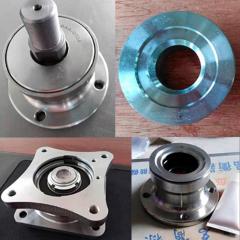
Among the most common options, round bore disc harrow bearings and square bore disc harrow bearings are widely used but serve different purposes. While they may look similar, their performance under load, vibration, and harsh field conditions can vary significantly.
This guide will help you clearly understand the differences and choose the most suitable bearing based on real working conditions.

Agricultural machinery working
2. Why Disc Harrow Bearings Matter
Disc harrow bearings operate under extreme conditions, including:
- Heavy soil resistance
- Constant vibration and shock loads
- Dust, mud, and moisture exposure
Choosing the wrong bearing can result in:
- Frequent bearing failure
- Increased maintenance costs
- Reduced machine uptime
Selecting the right type—whether round bore or square bore disc harrow bearings—ensures stable operation and longer service life.
3. What Are Round Bore Disc Harrow Bearings?
Round bore disc harrow bearings feature a circular inner hole designed to fit standard shafts.
Advantages
- Cost-effective – ideal for budget-sensitive projects
- Easy installation – quick mounting with standard shaft designs
- Widely available sizes – suitable for general applications
Limitations
- Lower resistance to shaft slipping under heavy load
- Not ideal for high vibration conditions
Typical Applications
Round bore bearings are commonly used in:
- Light-duty disc harrows
- Seeders and small tillage equipment
- Moderate working environments
4. What Are Square Bore Disc Harrow Bearings?
Square bore disc harrow bearings are designed with a square inner hole, which locks directly onto the shaft.
Advantages
- Higher load capacity for heavy-duty applications
- Stronger anti-slip performance under torque
- Better stability in high vibration environments
Limitations
- Higher initial cost
- More precise installation required
Typical Applications
Square bore bearings are ideal for:
- Large disc harrows
- Heavy-duty tillage equipment
- Harsh environments (mud, moisture, uneven terrain)
5. Round Bore vs Square Bore Disc Harrow Bearings (Direct Comparison)
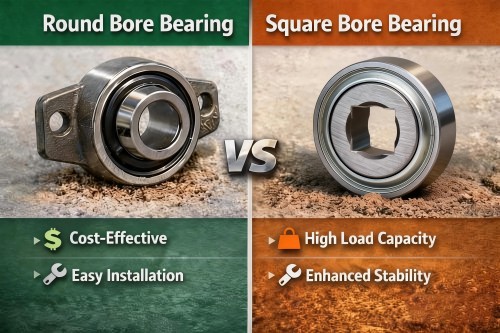
Round vs square bore bearings comparison
When comparing round bore vs square bore disc harrow bearings, the key differences are not just structural—they directly affect performance in real working conditions.
Feature
Round Bore Disc Harrow Bearings
Square Bore Disc Harrow Bearings
Installation
Simple and fast
Requires precise alignment
Load Capacity
Suitable for light to medium loads
Designed for heavy loads
Stability
May slip under high torque
Strong anti-slip performance
Durability
Moderate
Longer lifespan in harsh conditions
Cost
Lower upfront cost
Higher upfront cost
Working Conditions
Low vibration, standard fields
High vibration, tough environments
In simple terms:
- Choose round bore disc harrow bearings for cost efficiency and lighter work
- Choose square bore disc harrow bearings for durability and heavy-duty performance
6. Greaseable vs Non-Greaseable Disc Harrow Bearings
Another important factor when selecting disc harrow bearings is whether they are greaseable.
Greaseable Disc Harrow Bearings
- Can be re-lubricated regularly
- Longer service life under heavy use
- Suitable for high-load or continuous operation
Best for:
- Large farms
- Heavy-duty machinery
- Long operating hours
Non-Greaseable (Sealed) Disc Harrow Bearings
- Pre-lubricated and sealed
- Maintenance-free
- Easier to use but shorter lifespan in extreme conditions
Best for:
- Light-duty applications
- Users who prefer low maintenance
Key Takeaway
- Greaseable round bore disc harrow bearings → better for longer life with maintenance
- Non-greaseable round bore disc harrow bearings → better for simplicity
- Heavy-duty machines often combine square bore + greaseable design for maximum durability
Practical Application Suggestions:
- For equipment used in hilly or paddy field conditions in China, where muddy and wet conditions prevail, square bore bearings are preferable due to their resistance to corrosion and better load capacity.
- For light-duty operations in plains or flatlands, round bore bearings can meet basic needs at a lower cost.
7. Disc Harrow Bearing Sizes and Shaft Fit
Choosing the correct disc harrow bearing sizes is critical for proper performance.
Key considerations:
- Inner diameter must match shaft size
- Outer diameter must fit housing correctly
- Square bore bearings require exact shaft matching
Practical tip:
If your equipment operates under heavy torque, square bore disc harrow bearings reduce the risk of shaft slipping compared to round bore designs.
8. How to Choose the Right Disc Harrow Bearings
When selecting between round bore vs square bore disc harrow bearings, consider these factors:
① Load and Working Intensity
- Light-duty → round bore
- Heavy-duty → square bore
② Working Environment
- Dry, stable fields → round bore
- Muddy, wet, uneven terrain → square bore
③Maintenance Preference
- Want low maintenance → non-greaseable
- Want longer life → greaseable
④Budget vs Long-Term Cost
- Lower upfront cost → round bore
-
Better long-term value → square bore
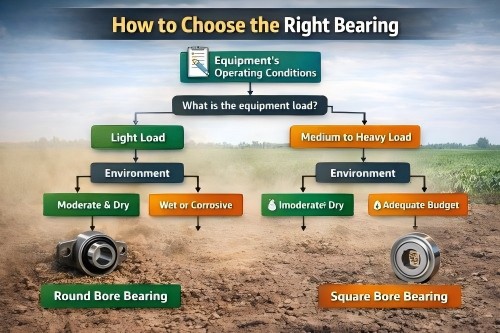 Bearing selection decision tree
9. Frequently Asked Questions
Q1: Can round bore bearings be replaced with square bore bearings?
In most cases, no. The shaft and housing design are different, so modifications are usually required.
Q2: Which type lasts longer?
Under heavy load and harsh conditions, square bore disc harrow bearings generally last longer.
Q3: Are greaseable bearings always better?
Not always. They last longer but require regular maintenance. For light-duty use, non-greaseable bearings are often sufficient.
10. Conclusion
Choosing between round bore vs square bore disc harrow bearings depends on your equipment, working conditions, and maintenance strategy.
- For light-duty and cost-sensitive applications → round bore disc harrow bearings
- For heavy-duty, high-vibration environments → square bore disc harrow bearings
If your goal is to reduce downtime and improve long-term performance, selecting the right bearing type is a critical decision—not just a component choice.