

Finding a suitable replacement tapered roller bearing can be challenging when an original model is discontinued, unavailable from the existing supplier, or identified by an unfamiliar manufacturer reference. For bearing distributors, importers, OEM purchasing teams, and aftermarket suppliers, the challenge is not simply finding a similar part number or matching external dimensions. The proposed replacement must also meet the original bearing specifications and equipment requirements.
In markets such as Brazil and Argentina, replacement orders may involve agricultural machinery, commercial vehicles, and industrial equipment from different manufacturers. Buyers may need to compare inch and metric references, identify alternative models across brands, or source several bearing types in one order.
A practical sourcing process starts with the original bearing part number or available dimensions. Buyers can then use manufacturer catalogs and cross-reference information to identify potential alternatives, compare the complete bearing specifications, and verify compatibility before ordering.
This guide explains how to find replacement tapered roller bearings by part number and dimensions, what to check when the original information is incomplete, and how to prepare an efficient inquiry for replacement or bulk purchasing.
Quick Guide: How to Find a Replacement Tapered Roller Bearing
Follow these steps when searching for a replacement tapered roller bearing:
-
Identify the original bearing reference. Record the complete part number and determine whether it refers to a complete bearing, cone, or cup.
-
Search manufacturer catalogs and cross-reference data. Use the original reference to find potential alternatives from other manufacturers.
-
Compare the available dimensions. Check bore diameter, cup outside diameter, total width, and individual component dimensions where available.
-
Verify the complete bearing combination. Confirm cone-and-cup compatibility and check the requirements of the original equipment.
-
Prepare the purchasing information. Provide the bearing reference, available specifications, application, quantity, and destination when requesting a quotation.
A matching part number or similar dimensions can narrow down the options, but neither alone confirms that two tapered roller bearings are interchangeable.
1. Identify the Original Tapered Roller Bearing Part Number
The original bearing reference is usually the most useful starting point for a replacement search. Before comparing products from different manufacturers, buyers need to establish exactly which bearing or component is required.
1.1 Identify the Complete Bearing Part Number
Start by checking the markings on the original tapered roller bearing, its packaging, or the equipment manufacturer's parts documentation.
Record the complete part number, including all letters, numbers, and suffixes. These details may distinguish different bearing designs, dimensions, or configurations within the same series.
Do not rely only on the main numerical portion of a bearing reference. Two models with similar base numbers may have different specifications or component combinations.
For replacement sourcing, record the following information whenever available:
-
Complete bearing part number
-
Original bearing manufacturer
-
Equipment manufacturer and model
-
Bearing position or assembly location
-
Any available OEM part number
If the original marking is incomplete or difficult to read, check the equipment manufacturer's parts catalog, maintenance documentation, or previous purchasing records.
This initial identification helps prevent searching for an individual component when a complete bearing is required, or selecting a bearing from the wrong product series.
1.2 Distinguish Bearing Part Numbers from OEM References
An equipment manufacturer may identify a bearing using an OEM part number rather than the bearing manufacturer's standard reference.
These references serve different purposes:
-
Bearing manufacturer part number: Identifies a bearing model or an individual bearing component.
-
OEM part number: Identifies a replacement part or assembly reference used in the equipment manufacturer's documentation.
-
Cone or cup number: Identifies an individual component of a tapered roller bearing.
Before searching for an alternative, determine what the available reference actually identifies.
For example, an OEM reference may correspond to a complete bearing assembly, while a bearing manufacturer's catalog may list the cone and cup separately. Treating these references as identical can lead to an incorrect product selection.
If the original bearing is supplied as a specific cone-and-cup combination, keep both component references whenever possible. They will be useful when checking cross-reference information and confirming the proposed replacement.
2. Find Potential Replacement Models Through Bearing Cross-Reference
Once the original bearing reference has been identified, buyers can search for potential alternatives from other manufacturers.
Bearing cross-reference information helps compare product references and locate models that may meet the same replacement requirements. However, a cross-reference result should be treated as a candidate for further verification, not as automatic confirmation of interchangeability.
2.1 Search Manufacturer Catalogs and Cross-Reference Data
Start with the original manufacturer's catalog or technical documentation. Locate the complete bearing reference and check its series, dimensions, and component information.
Then compare the reference with catalogs from other bearing manufacturers.
A useful cross-reference search should help identify:
-
Corresponding references from different manufacturers
-
Older and superseded bearing models
-
Alternative product series
-
References for complete bearings or individual components
-
Available dimensional and technical specifications
Manufacturer catalogs are particularly useful because they provide more than a model number. They allow buyers to compare the actual product specifications rather than relying on an isolated online listing.
SKET provides a range of tapered roller bearing models in different series. Buyers can review the SKET tapered roller bearing product range to identify relevant product references.
For example, the SKET 7800 Series tapered roller bearing page provides product references and dimensional information that can support model comparison. Any proposed cross-reference should still be checked against the original manufacturer's specifications.
2.2 Compare Inch and Metric Bearing References
Tapered roller bearings are available in both inch-based and metric-based dimensions. This is important when sourcing replacement bearings for equipment originally manufactured in different countries or supplied through different markets.
For example, a bearing distributor in Brazil may need to source replacement bearings for agricultural machinery imported from North America, while also purchasing metric bearings for other equipment.
When comparing inch and metric references:
-
Confirm the original measurement system.
-
Convert dimensions using accurate unit conversions.
-
Retain sufficient decimal places during comparison.
-
Compare actual catalog dimensions rather than rounded values.
-
Check the complete bearing reference and component combination.
For reference, 1 inch equals 25.4 mm. However, converting a dimension from inches to millimeters does not establish that two bearing models have the same design or are interchangeable.
For distributors managing mixed equipment inventories, recording both the original reference and converted dimensions can make future replacement searches more efficient.
2.3 Verify Cross-Reference Results Before Selecting a Replacement
After searching manufacturer catalogs, buyers may find several possible alternative references. The next step is to determine whether the cross-reference information is reliable enough to support product selection.
Check the following:
-
Is the alternative reference supported by manufacturer documentation?
-
Does the reference identify a complete bearing or an individual cone or cup?
-
Are the listed dimensions consistent with the original specifications?
-
Is the proposed component combination confirmed?
-
Are additional technical details required before approving the replacement?
It is important to distinguish three terms:
-
Cross reference: A reference used to identify a corresponding or potentially equivalent bearing model.
-
Interchange: Confirmation that one bearing can replace another under the specified requirements.
-
Replacement: A bearing selected to meet the dimensional, component, and application requirements of the original equipment.
A cross-reference listing identifies a potential alternative, but it does not automatically confirm dimensional, component, or application compatibility.
If the available information is incomplete, provide the original part number and specifications to the bearing supplier for further review before placing an order.
3. Compare Tapered Roller Bearing Dimensions Before Ordering
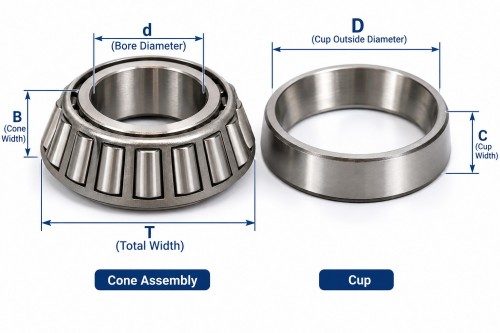
When the original part number is unavailable, incomplete, or difficult to verify, dimensional comparison becomes an important part of the replacement search.
Even when a potential alternative has been identified through cross-reference data, buyers should compare the actual bearing dimensions before proceeding.
3.1 Use the Main Dimensions to Screen Potential Replacements
The three main dimensions used for an initial tapered roller bearing comparison are:
-
Bore Diameter (d): The inside diameter of the bearing cone.
-
Cup Outside Diameter (D): The outside diameter of the bearing cup.
-
Total Bearing Width (T): The overall width of the assembled bearing.
These dimensions help buyers narrow down potential replacement models and eliminate products with clearly different dimensions.
If the original bearing information only includes d, D, and T, these measurements can still provide a useful starting point. Buyers can compare them with manufacturer catalog data to identify candidate models.
However, the three dimensions alone cannot confirm that the proposed replacement has the correct cone-and-cup combination or meets all original equipment requirements.
Dimensional screening should therefore be used to narrow down the options, not as the final basis for approving a replacement.
3.2 Check Cone and Cup Dimensions Separately
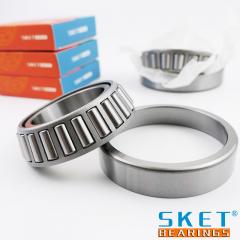
A tapered roller bearing consists of two separable main components:
-
Cone assembly: The inner ring, rollers, and cage.
-
Cup: The outer ring.
Because these components can be separated, buyers should check their individual dimensions and references whenever the original information is available.
Common dimensional references include:
| Dimension | Description |
|---|---|
| d | Cone bore diameter |
| D | Cup outside diameter |
| B | Cone width |
| C | Cup width |
| T | Total bearing width |
The B and C dimensions provide additional information beyond the overall bearing width. They help buyers compare the individual components and assess whether the proposed bearing combination corresponds to the original specification.
A replacement should not be selected simply because its cone or cup has a similar size. The corresponding components must be checked as a compatible combination using the relevant manufacturer specifications.
Also, dimensional designations and reference conventions should be checked against the applicable manufacturer catalog or bearing standard, particularly when comparing products from different series.
3.3 Confirm Inch and Metric Measurements When Information Is Incomplete
When comparing bearing dimensions from different catalogs, make sure all measurements use the same unit.
For reference:
-
1 inch = 25.4 mm
-
0.5 inch = 12.7 mm
-
0.25 inch = 6.35 mm
Avoid rounding dimensions too early. Small differences may affect the assessment of bearing fit and component compatibility.
Consider a distributor sourcing a replacement tapered roller bearing for imported agricultural machinery. The available information includes an original bearing reference and its bore diameter, cup outside diameter, and total width.
The distributor can first search the original reference in manufacturer catalogs, then compare the available dimensions to narrow down potential alternatives. If the complete bearing reference or component information is missing, additional specifications may be needed to confirm the correct model.
In this situation:
-
The original part number helps identify the bearing series.
-
The available dimensions help screen candidate models.
-
Cone and cup references help verify the component combination.
-
Equipment information helps confirm the intended application.
Dimensional screening narrows down the options, while complete specification verification determines whether a replacement is suitable.
For product-specific dimensional reference, SKET also provides a CR-1252 inch tapered roller bearing specification example. It illustrates how bearing dimensions can be presented for product evaluation, but should not be treated as evidence that the CR-1252 replaces another model.
4. Verify Replacement Bearing Compatibility Before Ordering
After identifying a potential replacement through part-number or dimensional comparison, buyers should complete a compatibility check.
This step helps prevent purchasing a bearing that appears similar in a catalog but does not meet the original equipment requirements.
4.1 Confirm the Complete Cone-and-Cup Combination
For tapered roller bearings, checking the complete bearing assembly is essential.
Determine whether the original reference identifies a complete bearing or separate cone and cup components. If the original equipment uses a specific cone-and-cup combination, verify that the proposed replacement includes the corresponding compatible components.
Before ordering, confirm:
-
Complete bearing model and reference
-
Cone part number, where applicable
-
Cup part number, where applicable
-
Compatibility between the cone and cup
-
Whether the order requires a complete bearing or individual components
This is particularly important for distributors purchasing replacement components in bulk. Ordering a cone or cup without confirming the corresponding component may result in an incomplete or unsuitable assembly.
4.2 Check Application and Operating Requirements
Dimensional compatibility is only one part of replacement selection. The bearing must also meet the requirements of the equipment in which it will be installed.
The same equipment category may use different bearing models depending on the manufacturer, model, bearing position, and assembly design.
Before confirming a replacement, identify:
-
Equipment type and model
-
Bearing installation position
-
Original bearing reference
-
Operating environment
-
Any special equipment or operating requirements
For agricultural machinery, for example, a replacement bearing may be used in a wheel, transmission, gearbox, or another assembly. Buyers should confirm the actual bearing position rather than selecting a model based only on the equipment category.
For truck and industrial applications, the same principle applies. Use the original equipment documentation or relevant bearing manufacturer's specifications to confirm the requirements.
4.3 Compare Critical Product Specifications
In addition to dimensions and component references, compare the product specifications relevant to the original application.
Depending on the bearing and equipment requirements, these may include:
-
Bearing design and configuration
-
Material specifications
-
Precision class
-
Internal clearance or other specified design parameters
-
Applicable manufacturer technical requirements
-
Quality and inspection documentation required for the order
Do not assume that a higher precision class or a different specification is automatically a better replacement. The proposed bearing should meet the original equipment requirements or an approved alternative specification.
For example, P0, P6, and P5 precision classes should be evaluated against the original design and application requirements rather than selected simply because one designation appears more advanced.
The objective is to confirm that the replacement meets the requirements of the equipment, not merely that it has a similar part number or external dimensions.
5. Source Replacement Tapered Roller Bearings for Different Applications
Replacement sourcing requirements vary by equipment type and customer business model. Agricultural machinery distributors, truck aftermarket suppliers, and industrial bearing importers may all need tapered roller bearings, but their purchasing priorities are different.
For buyers in South America, organizing original references, equipment information, and order quantities can make replacement sourcing more efficient.
5.1 Agricultural Machinery Replacement Orders
Agricultural machinery distributors and aftermarket suppliers in Brazil and Argentina may handle replacement parts for equipment from different manufacturers and model generations.
A single purchasing order may include several tapered roller bearing references for tractors, harvesters, planters, and other agricultural machinery.
For these orders, buyers should organize the original bearing references and equipment applications before requesting quotations. When the original model is unavailable, provide the available dimensions and component references so that potential alternatives can be reviewed.
For distributors serving agricultural customers, useful sourcing considerations include:
-
Identifying original bearing references for different equipment models
-
Checking inch and metric bearing specifications
-
Organizing multiple replacement models in one purchasing list
-
Confirming the required quantity for each model
-
Clarifying OEM or aftermarket purchasing requirements
For example, an agricultural parts distributor in Brazil may manage bearing requirements for several equipment brands. A consolidated model list containing the original references, available dimensions, and quantities helps suppliers review the requirements more efficiently.
5.2 Truck and Commercial Vehicle Aftermarket
Truck bearing distributors and commercial vehicle parts suppliers need accurate model identification when sourcing replacement bearings for different vehicle applications.
In markets such as Brazil, Argentina, Chile, and Peru, aftermarket businesses may handle parts for vehicles from different manufacturers and production periods. Original bearing references, OEM numbers, and dimensional specifications can therefore be important when checking replacement options.
Before requesting a quotation, buyers should identify the vehicle model, bearing position, and original bearing reference whenever possible.
For multi-model orders, a structured list helps suppliers distinguish between similar-looking bearing references and avoid confusion between complete bearings and individual components.
Truck aftermarket buyers should also clarify quantities, packaging requirements, and destination information when discussing wholesale supply.
5.3 Industrial Equipment Replacement Supply
Industrial bearing distributors and maintenance suppliers may need replacement tapered roller bearings for machinery from different manufacturers.
These orders can involve older equipment, discontinued bearing references, or products listed in different measurement systems.
In these situations, the original bearing part number is useful, but dimensional records and equipment documentation can also help identify potential alternatives.
For industrial replacement sourcing, buyers should prepare:
-
Original bearing reference and manufacturer
-
Available dimensional specifications
-
Equipment type and bearing position
-
Cone and cup references, where available
-
Required quantity and destination
For importers and distributors serving multiple industrial customers, consolidating these details into one model list can simplify cross-reference checks and quotation requests.
6. Evaluate Bearing Suppliers Before Placing a Bulk Order
Finding a potential replacement model is only one part of the sourcing process. Buyers also need to evaluate whether the supplier can support their product requirements, quality expectations, and order arrangements.
This is particularly important for distributors and importers purchasing several bearing models in one order.
6.1 Check Product Range and Replacement Sourcing Support
A supplier's product range should match the bearing types and references required by the buyer's customers.
For tapered roller bearing sourcing, check whether the supplier can support:
-
Relevant inch and metric models
-
Common replacement bearing series
-
Different bearing sizes and configurations
-
Multiple-model purchasing requirements
-
Review of original part numbers and available dimensional information
When sourcing replacement tapered roller bearings, buyers can provide original part numbers, OEM references, or available dimensional specifications for an initial product review.
For orders involving multiple models, a consolidated bearing list can help clarify the product requirements and quotation scope.
Do not assume that every model is in stock simply because it appears in an online product catalog. Confirm current availability and production arrangements for each required reference before placing an order.
6.2 Review Quality Control and Product Documentation
For replacement and bulk bearing orders, product consistency and documentation are important considerations.
Buyers should establish which quality checks and documents are relevant to their purchasing requirements.
Depending on the order, useful items to discuss may include:
-
Product dimensional inspection records
-
Material-related documentation, where applicable
-
Manufacturing and inspection requirements
-
Batch identification and traceability
-
Pre-shipment inspection arrangements
-
Other documentation specified by the customer
The required documents should be agreed upon before production or shipment. For OEM orders, buyers should provide the applicable drawings, specifications, and inspection criteria so that the supplier can evaluate the requirements.
Rather than relying on general quality statements, distributors and importers should confirm which inspection records and product documents can be provided for their specific order.
6.3 Confirm Bulk Supply and Export Arrangements
Bulk purchasing involves more than confirming the unit price. Buyers should also clarify the order scope and export arrangements before placing an order.
For multi-model replacement orders, confirm:
-
Quantity required for each bearing model
-
Whether OEM or replacement supply is required
-
Packaging and labeling requirements
-
Destination country
-
Required export and shipping documents
-
Expected production and shipment schedule
For distributors in South America, providing the destination country at the quotation stage helps suppliers assess the relevant export and delivery arrangements.
If the order includes several bearing references, submit a complete model and quantity list. This makes it easier to review the order as a whole rather than handling each model separately.
7. Prepare a Complete Inquiry for Replacement Bearing Orders
Once a potential replacement has been identified, the next step is to send the supplier enough information to review the model and prepare a quotation.
A complete inquiry does not require every technical detail to be available. Buyers can start with the information they have and provide additional specifications when requested.
7.1 Provide Bearing Identification and Specification Details
When requesting a replacement tapered roller bearing quotation, include as many of the following details as possible:
| Information | Details to Provide |
|---|---|
| Original Part Number | Complete bearing reference, if available |
| Original Manufacturer | Brand or manufacturer of the existing bearing |
| OEM Reference | Equipment manufacturer's part number, if available |
| Bore Diameter (d) | Original bore measurement |
| Cup Outside Diameter (D) | Original outside diameter |
| Total Width (T) | Overall bearing width |
| Cone Number | Individual cone reference, if available |
| Cup Number | Individual cup reference, if available |
| Application | Agricultural machinery, truck, industrial equipment, etc. |
If the complete part number is unavailable, provide the dimensions and equipment application instead.
For buyers who only have partial information, the original manufacturer's name, equipment model, or individual cone and cup references may still help narrow down the options.
The more accurate the available information, the easier it is to identify potential replacement models and determine which specifications need further confirmation.
You do not need to wait until every specification is available before making an initial inquiry.
7.2 Specify Quantity and Delivery Requirements
In addition to bearing specifications, buyers should include the commercial details needed for quotation.
These may include:
-
Required quantity for each model
-
Number of different bearing references
-
OEM or replacement order requirements
-
Packaging and labeling preferences
-
Destination country
-
Expected delivery schedule
For wholesale and distributor orders, a spreadsheet containing part numbers, dimensions, and quantities is a practical way to organize multiple models.
If the order involves several equipment applications, list the application beside each bearing reference. This helps reduce confusion when reviewing similar models.
Providing these details at the beginning of the inquiry allows the supplier to evaluate the product requirements and discuss quotation, availability, and export arrangements more efficiently.
Frequently Asked Questions About Replacement Tapered Roller Bearings
1. How Do I Find a Replacement Tapered Roller Bearing by Part Number?
Start by recording the complete original bearing part number, including any suffixes. Search the original manufacturer's catalog and cross-reference information to identify potential alternatives. Then compare the dimensions, cone-and-cup combination, and application requirements. A cross-reference result should be verified before treating it as a confirmed replacement.
2. Are Tapered Roller Bearings with the Same Dimensions Interchangeable?
Not necessarily. Matching bore diameter, cup outside diameter, and total width can help identify a potential alternative, but it does not confirm complete interchangeability. The cone-and-cup combination, bearing design, and original equipment requirements should also be checked before ordering.
3. How Do I Find a Tapered Roller Bearing Without a Complete Part Number?
If the complete part number is missing, start with the available dimensions, including bore diameter, cup outside diameter, and total width. If possible, also record the cone and cup references. Provide the equipment model and bearing application to the supplier so that potential models can be evaluated against the available information.
4. Are Inch and Metric Tapered Roller Bearings Interchangeable?
Not automatically. Inch and metric bearings may have similar dimensions after unit conversion, but this does not establish that their designs or component combinations are identical. Compare the original specifications with manufacturer catalog data and confirm the proposed replacement before purchasing.
5. What Information Should I Provide When Requesting a Bulk Bearing Quote?
Provide the bearing part number, original manufacturer, available dimensions, cone and cup references if applicable, application, and required quantity for each model. Also include the destination country, packaging requirements, and expected delivery schedule. If some technical information is unavailable, submit the details you have for an initial review.
Looking for Replacement Tapered Roller Bearings?
SKET supports tapered roller bearing sourcing for replacement, OEM, and wholesale purchasing requirements.
Whether you are a bearing distributor in Brazil, an agricultural machinery parts supplier in Argentina, a truck aftermarket importer, or an industrial bearing buyer, providing the original part number and available specifications is a practical starting point for identifying relevant products.
For replacement and bulk purchasing inquiries, send us:
-
Original bearing part number or OEM reference
-
Available dimensions
-
Required quantity for each model
-
Equipment application
-
Destination country
For multi-model orders, you can also provide a bearing list with the corresponding quantities and specifications.
Contact SKET to discuss your replacement tapered roller bearing requirements and request a quotation.